Main Concepts v0.0.12
Klio is built on top of two foundational technologies:
- PostgreSQL's native physical backup infrastructure
- The CloudNativePG Interface (CNPG-I) for backup and recovery
PostgreSQL has provided native continuous backup and point-in-time recovery (PITR) capabilities since version 8.0, released in 2005, enabling reliable disaster recovery and business continuity for mission-critical systems worldwide.
Info
PostgreSQL offers logical backups using tools like pg_dump, which generate a
logical representation of the database as SQL statements or data files. Logical
backups do not provide continuous protection or point-in-time recovery
capabilities. As a result, they are not suitable for business continuity
scenarios in mission-critical environments where minimizing downtime and data
loss is essential.
At its core, PostgreSQL’s continuous backup and recovery system uses physical (file system level) copies combined with write-ahead log (WAL) archiving. This approach enables consistent, recoverable backups while keeping systems online, a strategy proven effective in production environments for over two decades.
In a PostgreSQL backup solution, the infrastructure typically consists of:
- WAL Archive: A designated location for continuously archived WAL (write-ahead log) files, preserving all changes made to the database to support data durability and recovery.
- Physical Base Backups: A consistent copy of all data files used by
PostgreSQL (primarily the
PGDATAdirectory and any tablespaces), forming the foundational layer for any recovery operation.
The diagram below illustrates the relationship between physical base backups and the WAL archive over time:
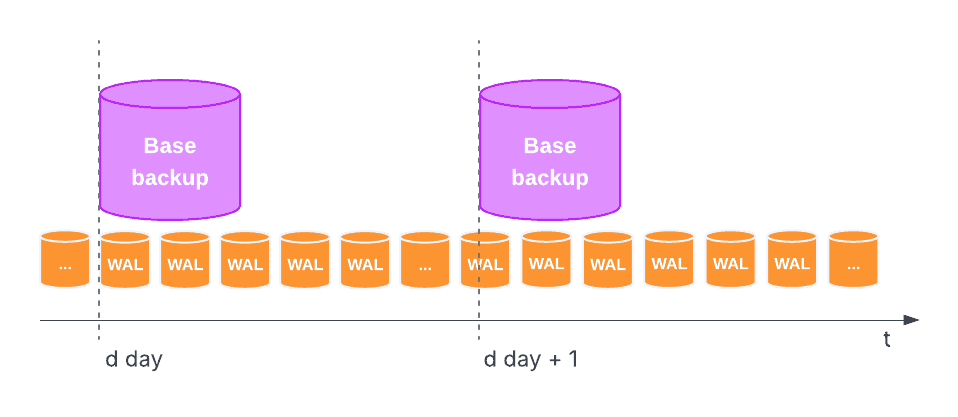
WAL Archive
The WAL archive is central to continuous backup in PostgreSQL and is essential for:
- Hot (Online) Backups: Allowing physical base backups to be taken from any node (primary or standby) without shutting down PostgreSQL, ensuring backups can proceed without service disruption.
- Point-in-Time Recovery (PITR): Enabling recovery to any precise moment after the earliest available base backup, using archived WAL files to replay transactions up to the desired recovery point.
Important
WAL archives on their own are insufficient for disaster recovery. A physical base backup is required to restore a PostgreSQL cluster.
Using a WAL archive significantly enhances the resilience of a PostgreSQL system. WAL files can be fetched by any PostgreSQL instance for replication or recovery, with archives typically retaining WAL segments longer than local retention policies, ensuring historical data is preserved for PITR and disaster recovery workflows.
Klio receives WAL content from a PostgreSQL primary via streaming replication.
Physical base backups
PostgreSQL supports physical base backups as the cornerstone of its
disaster recovery and PITR strategies. A base backup is a consistent, file
system-level copy of all data files used by a PostgreSQL cluster, including
the PGDATA directory and any additional tablespaces.
Key properties of PostgreSQL base backups:
- Online (Hot) Backups: Base backups can be taken while the database is online, avoiding downtime. PostgreSQL maintains consistency during an online backup by coordinating with its write-ahead logging system, ensuring a valid restore point.
- Foundation for PITR: A base backup provides the starting point for point-in-time recovery. After restoring the base backup, archived WAL files are replayed to advance the system to a specific recovery target, allowing precise restoration following accidental data loss or corruption.
- Efficient Storage and Transport: Base backups can be compressed and streamed to external or object storage, supporting offsite and cloud-based disaster recovery workflows.
Klio leverages CNPG-I to coordinate the hot backup procedure, using
PostgreSQL’s pg_backup_start and pg_backup_stop concurrent API to ensure
consistency. It uses Kopia to efficiently
transfer backup data across locations, ensuring backups are portable,
secure, and space-efficient.
Recovery
In PostgreSQL, recovery is the process of restoring a database cluster from a physical base backup, bringing it to a consistent state by replaying write-ahead log (WAL) files, which contain the necessary redo information for all changes made after the backup.
PostgreSQL’s recovery system supports Point-in-Time Recovery (PITR), enabling you to restore a cluster to any precise moment between your earliest base backup and the latest available WAL segment. To perform recovery, a valid WAL archive is required alongside the physical base backup.
Klio follows the approach of CloudNativePG and implements the recovery part of CNPG-I. It does not perform in-place recovery on an existing cluster; instead, recovery is used to bootstrap a new cluster from a base backup and replay WAL files to reach a desired state.
Recovery can operate in two primary modes: full recovery (replaying WAL files to the latest available segment) or Point-in-Time Recovery (PITR), allowing restoration to a chosen state before an incident such as accidental data deletion. Klio supports all PITR targets provided by CloudNativePG, including time, restore point, and transaction.
- On this page
- WAL Archive
- Physical base backups
- Recovery