WAL Streaming v0.0.12
A standout feature of Klio is its native, cloud-first implementation of WAL streaming for PostgreSQL. This architecture enables:
- Partial WAL segment streaming, ensuring real-time data transfer
- Built-in compression and encryption using user-provided keys
- Controlled replication slot advancement, protecting against WAL loss
- Optional synchronous replication, offering zero RPO when enabled
Architecture
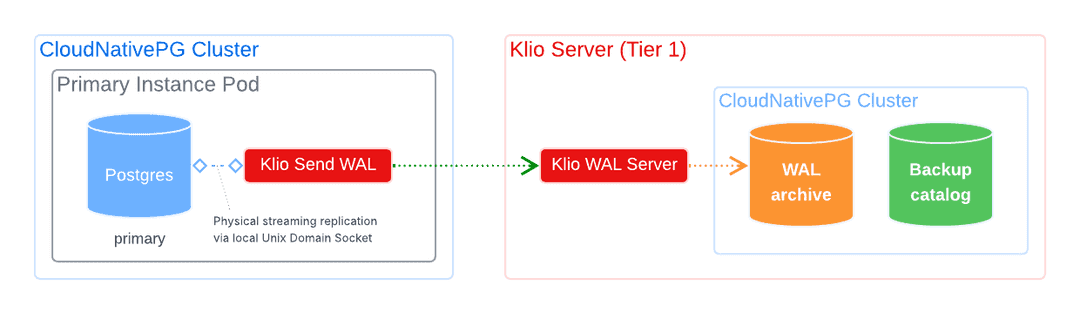
WAL streaming in Klio is built around two components: a client and a server.
- The client, invoked using the
klio send-walcommand, typically runs alongside PostgreSQL but does not have to. - The server, started with the
klio server start-walcommand, runs as a dedicated process on the Klio server.
In Kubernetes environments, as illustrated in the diagram above, Klio streams WAL records directly from the PostgreSQL primary over a local Unix domain socket. The WAL streamer runs as a lightweight sidecar container within the same pod as the primary instance and is managed by the CNPG-I–compliant plugin. It continuously pushes data to a remote Klio WAL server (Tier 1), which handles partial WAL file synchronization and archives completed segments into the central WAL archive for the PostgreSQL cluster.
Moving Beyond archive_command
Klio replaces the traditional PostgreSQL archive_command method for WAL
handling in CloudNativePG clusters, providing improved reliability, efficiency,
security, and observability.
PostgreSQL’s archive_command is a shell command executed when a WAL segment
is complete—either because the segment reached its size limit (typically 16MB)
or the archive_timeout elapsed (5 minutes by default in CloudNativePG).
The streaming model provided by Klio offers several key advantages over this approach:
Near-zero RPO: WAL changes are streamed incrementally in near real-time, reducing the worst-case recovery point objective (RPO) from 5 minutes to near-zero, or even zero in synchronous mode.
Improved efficiency and scalability: A single, continuously running WAL streamer process replaces the need to spawn a new process for each WAL segment, resulting in lower CPU and I/O usage and better scalability during periods of high WAL volume.
Enhanced security: WAL data is encrypted end-to-end, both in transit and at rest, providing protection not available with the traditional
archive_command.Comprehensive observability: Native metrics and structured logging provide full visibility into WAL streaming operations, simplifying monitoring, anomaly detection, and troubleshooting compared to the opaque nature of
archive_command.
Monitoring Klio WAL Streamer in PostgreSQL
The Klio WAL streamer is a PostgreSQL streaming replication client and,
as such, can be monitored using the standard pg_stat_replication
system view in the PostgreSQL catalog.
The WAL streamer identifies itself with application_name set to klio.
To verify whether any Klio WAL streamer is connected to an instance (in Kubernetes deployments, this will always be the primary), run the following query:
SELECT * FROM pg_stat_replication WHERE application_name = 'klio';
An example output might look like this:
The following excerpt is an a example:
-[ RECORD 1 ]----+------------------------------
pid              | 1070
usesysid         | 10
usename          | postgres
application_name | klio
client_addr      |
client_hostname  |
client_port      | -1
backend_start    | 2025-08-07 01:14:39.619662+00
backend_xmin     |
state            | streaming
sent_lsn         | 2/C765A000
write_lsn        | 2/C75FA000
flush_lsn        | 2/C741A000
replay_lsn       | 2/C741A000
write_lag        | 00:00:00.919907
flush_lag        | 00:00:00.923556
replay_lag       | 00:00:00.923556
sync_priority    | 0
sync_state       | async
reply_time       | 2025-08-07 01:54:44.756306+00
As you can see, Klio provides relevant feedback to PostgreSQL. Here is a brief explanation of the key fields:
state: The replication connection status (streamingindicates active streaming).sent_lsn,write_lsn,flush_lsn,replay_lsn: Positions in the WAL indicating how far data has been sent, written, flushed, and replayed on the Klio server (replayed and flushed are always identical).write_lag,flush_lag,replay_lag: Delays between WAL positions indicating replication latency.sync_state: The synchronization state of this standby (e.g.,async,sync,potential,quorum).